Seton Hall Law’s Institute for Privacy Protection and Gibbons Institute of Law, Science & Technology is hosting a Virtual Event on September 17th with legal academics, practitioners, and government officials who will evaluate the impact of the COVID-19 pandemic on privacy and intellectual property. Panel One speakers will discuss balancing privacy & public health; Panel Two will discuss Intellectual Property – incentives to access to vaccines & treatments.

This past Tuesday the FTC hosted its 5th annual PrivacyCon. It was a GREAT event! The full-day event covered a wide-range of cutting edge and titillating issues concerning the privacy of data in this day and age of rapidly accelerating technology. However, it was the morning session which covered Health Apps that interested me the most. In his opening remarks, the Director of FTC’s Bureau of Consumer Protection, Andrew Smith, came out-of-the-gate pointing out that earlier this year HHS issued rules that will make it easier for consumers to access their medical records through the app of their choice, and while this expanded access to health information can be an enormous benefit to consumers – wherever data flow opportunities increase, the opportunities for data compromise increase as well. Director Smith concluded his opening remarks by stating “We at the FTC will not hesitate to take action when companies misrepresent what they are doing with consumers’ health information or otherwise put health data at undue risk . . .” Here is what I learned from the four-person panel of experts who discussed the ins-and-outs of Health Apps and potential direction of the FTC will take with enforcement.
Becker’s Hospital Review reported that 70% of CIOs are “concerned” about meeting the upcoming November 2nd deadline for complying with the Final Rules prohibiting information blocking practices. This is according to a survey conducted by CHIME, which included responses from executives at academic medical centers, critical access hospitals, multi-hospital systems and specialty hospitals. Although the survey did not appear to identify specifically what concerns CIOs about complying with information blocking rules by this fall, one possibility is fully understanding how ONC’s information blocking rules will apply to releasing patients’ EHI to third-party apps.
The Exposure Notification Privacy Act (“ENPA”) was introduced in the Senate on June 1 in an effort to regulate the growth of contact tracing applications and similar automated notification tracking. The ENPA aims to regulate websites, apps and similar services...
Deciding whether “to block, or not to block” health information based on an exception laid out in ONC’s Final Rule can quickly turn into a Shakespearean tragedy unless Actors understand in advance the specific criteria that must be met in order to satisfy any such applicable exception.
As part of its comprehensive COVID-19 response, Congress quietly passed through changes to the federal drug and alcohol confidentiality framework known as “Part 2” under the CARES Act, enacted on March 27. One of the more underreported components of the CARES Act, the changes do not completely overhaul the Part 2 regulations, however, they relax several restrictions that health care providers have struggled with, particularly in the electronic exchange and electronic health records (“EHR”) context (the “CARES Act Changes”).
Under the ONC’s Final Rule on Information Blocking, Health Care Providers, HIEs and HINs will be legally prohibited from interfering with the access, exchange, or use of EHI unless an exception applies. However, HIEs/HINs that are HIPAA Business Associates are not allowed to use or further disclose PHI other than as permitted or required by their HIPAA BAAs with respective health care providers. So, what happens if a Health Care Provider and its HIPAA Business Associate HIE/HIN disagree on whether an exception allows EHI to be withheld from access, exchange or use under a certain set of specific facts?
On April 9th, HHS announced a new Notification of Enforcement Discretion Regarding COVID-19 Community Based Testing Sites. The Notification of Enforcement Discretion has a retroactive date to March 13, 2020. The HHS Notification informs the public that it is exercising its discretion...
SAMHSA Public Session to Discuss Part 2 Regulations & HIE The Part 2 regulations which govern and protect information created by drug and alcohol rehabilitation providers have caused challenges for electronic health information exchange ever since HIE became a household term (….ok, well at...
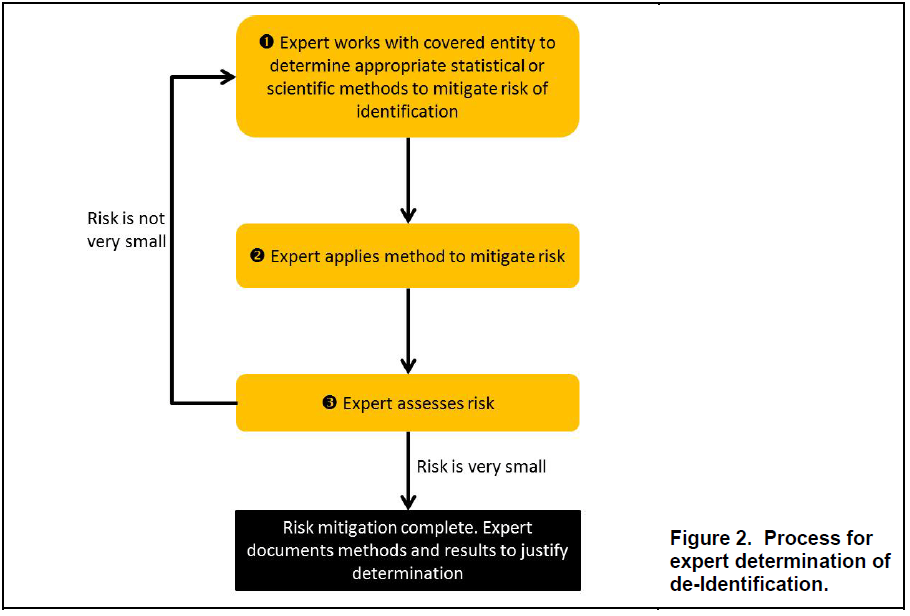
OCR Releases HIPAA De-identification Q&A Guidance
With the weekend coming up, why not take a break from the holiday frenzy and read through OCR’s new HIPAA De-identification guidance. The approximately 30-page guidance document is an easy read, even for those of us who aren’t...
We “Like” Organ Donor Status on Facebook This post has been prepared by Christina Strong, Esq. The addition of “organ donor status” to Facebook is a tremendous boon for the communication of what is fast becoming a social norm, altruistic donation of one’s body, to take place after death. Unlike...
Grantees of HIE Funds Get “PIN-ned” on Privacy, Security and Patient Consent On March 22, 2012 HHS/ONC released a new Program Information Notice (PIN) called the “Privacy and Security Framework Requirements and Guidance for State Health Information Exchange Cooperative Agreement Program” (P&S...
When DHHS published its Proposed ACO Rule in April 2011 and then the Final ACO Rule in November 2011 (I’ll refer to them as the “ACO Rules”), discussions focused predominately on issues such as who is “qualified” to participate, what the required governance structure should be, what methodology will be used to assign Medicare beneficiaries, and what the payment models will be. However, as I digested the ACO Rules, my reading deliberately slowed down as I zeroed in on the not unremarkable language and comments CMS included with regard to sharing individually identifiable health information in the ACO context.
California HIE Demonstration Projects to Move Ahead with Opt-In Framework
This past Wednesday, the California Office of Health Information Integrity (CalOHII) released a comprehensive whitepaper examining patient consent and other HIE framework efforts for entities participating in the...
Supreme Court to Hear Arguments on Suit for Damages under the Privacy Act
The Supreme Court is scheduled to hear oral arguments tomorrow, November 30, in a suit for damages under the Privacy Act stemming from a wrongful disclosure of confidential information. Federal Aviation...